
· 14 min read · Updated
Weight-Loss Injections and Mental Health
Katharina Helms · Psychologist (M.Sc. Clinical Psychology)
The substances now known as weight-loss injections came to market as diabetes drugs, one of them under the name Ozempic. They mimic a gut hormone called GLP-1, and the fact that it also dampens appetite was a side discovery. Approval for weight loss came only years later.[1]
Now that side effect has become the main reason people take them, and slimness is a goal again. The debate turns on kilograms, cost, nausea and muscle loss. Hardly anyone asks what changes in the mind. Yet that is the first thing users report: the constant thinking about food eases off. Many only notice then how loud it had been.
The drug can switch that noise off. But the quiet does not last, and there is much it never reaches.
- in the body
- 2what is known8what happens after stopping
- in the mind
- 1what happens there4feeling emotionally dulled5when it does not work7the look in the mirror9self-judgement
- between people
- 6the charge of cheating10taking it without a diagnosis
- 3why people reach for it11what the choice depends on12where counselling comes in
What happens in the mind when hunger goes quiet
GLP-1 is one of several hormones the gut releases after eating. It belongs to the peptides, those short chains of protein the body also builds itself as messengers. The receptors for GLP-1 do not sit only in the digestive tract. They sit in the brain too, where fullness is registered, and the substance reaches at the same time into the pathways that carry reward.[2] Many notice the effect in the head before it shows on the scales, which matches where the receptors sit. The noise that stops has a name: food noise. It means the craving that runs alongside hunger: the circling around the next meal, around what is left in the fridge, around the question of whether anything else is still an option today.
And for some, it is not only food that goes quiet. Users report that the pull towards alcohol, towards cigarettes, towards the evening shopping trip fades as well. A drug against appetite ought to stop at food. This one does not, and none of those other things has anything to do with nourishment. Food noise may then have more in common with the urge for a cigarette than with a rumbling stomach.
What we know about the physical effects, and what we don’t
The body is better studied than the mind. The short-term effects are well described. Nausea and stomach complaints affect many, usually mildly, and some stop the treatment because of them. As with any weight loss, muscle mass goes along with it. On cancer, the pancreas and the thyroid, the data from the approval trials and a meta-analysis are reassuring. A cohort study of people on weight-loss medication, by contrast, found a raised risk of pancreatitis and of bowel obstruction, and the US regulator has added a warning about bowel obstruction, without a causal link having been proven.[1] On suicide risk, the clinical trials taken together found no increase. They ran only briefly, though, and people with existing mental illness were often excluded.[2]
What happens over years is in none of those studies. Rare consequences with a long lead time cannot show up in approval trials, which do not run long enough. Twenty-five anti-obesity drugs were withdrawn from the market for safety reasons between 1964 and 2009.[3] The current ones are licensed for obesity, and from a body mass index of twenty-seven when a weight-related condition comes with it.[1] That threshold marks where the risk is deemed acceptable. How large that risk is in the long run, nobody yet knows.
They are now also prescribed online, after an online questionnaire. The figures the threshold is checked against then come from the person who wants to cross it.
Why people reach for it
These drugs are meant for people whose weight is a burden on their health, and for many that is exactly the reason.[1] Others have a long run of attempts behind them that did not last. Others again describe above all that the noise around food stops, and only then notice how much room it had taken. People who turn to a drug have rarely made little effort.
Can weight-loss injections dull your emotions?
Some users get an effect in the mind that nobody asked for. In personal accounts and press interviews, people describe how, along with appetite, other things have gone quiet too: the appetite for hobbies, for closeness, for company. None of this has been studied systematically.[2] The accounts mark an open question; the answer is not in yet. Anyone who notices such a change during treatment is best advised to raise it with a doctor.
An explanation is close at hand: a substance that reaches into the pathways of reward does not reach into food alone. Against it, though, stands a result that should have pointed the same way and does not. In a double-blind, placebo-controlled study of people with depression and overweight, the substance lowered the perceived cost of effort relative to the reward over sixteen weeks.[4] More willingness to act, then, not less. The study is small, it was a secondary analysis, and what it measured was willingness to make an effort, not enjoyment.
Why the injections do not work for some people
The most awkward question about these drugs is what happens when they do not work. Yet the answer sits in the licensing trials themselves. Somewhere between one in ten and one in six participants lost so little that the treatment counted as ineffective. At the same time, just over a third lost more than a fifth of their body weight.[1] Both figures come from the same trials, at the same dose, over the same period. The average sits between them. For groups this can be predicted to some extent, for the individual not yet reliably.
Everyone starts at the same point. Who ends up in which group cannot be said in advance. How much of the loss lasts hangs on the same three groups: 8the curve after stopping What is sourced is where each band ends after 68 weeks; the path there is estimated, because no trial reports it week by week. Source: Tzoulis and Baldeweg 2024
Three bands fan out downward from a single shared starting point. Distribution of weight loss in the licensing trials: 14 in 100 lost almost nothing (under 5 %, 10 to 17, depending on the trial), 50 in 100 lost a good deal (5 to 20 %, the remainder, where the average sits), 36 in 100 lost a great deal (over 20 %, 32 to 40, depending on the trial).The reasons under investigation are metabolism, diabetes, genetics, sex, age and ethnicity. Men lose considerably less weight on the substance, on average, than women do, and people with diabetes less than people without.[1] How full someone feels after the same meal differs from person to person. Discipline is not investigated. Food is, but as hunger, satiety and craving. As sensation, then, not as decision. What someone does makes a difference. It just does not explain why the same dose works for one person and not for another. How hard someone tried cannot be read off the weight they lost.
Is losing weight with medication “cheating”?
There is a judgement almost everyone knows and hardly anyone says out loud. It was studied in four experiments with more than a thousand people across three countries. Participants assessed two people who had lost exactly the same amount of weight. The only difference was that one of them had used a drug.
On average, the person who had used the drug was rated as less moral, less capable and less warm.[5]
The mechanism behind it has a name: effort is equated with moral worth. Those who suffered for it earned it. Those who made it easier on themselves cheated. That the outcome is identical changes nothing. Blood pressure is not counted this way: a reading lowered with tablets counts as treated, not as obtained by cheating.
What was measured is how other people react. It says nothing about the person who is losing weight. Anyone who expects such reactions does not mention the drug. Then the compliments on the weight loss arrive. Saying so now risks the devaluation, which is exactly what the silence prevented. Whoever says nothing accepts the praise. The weight loss is real, and the praise has reached the right person.
It still often feels as though it were meant for somebody else. For a moment one plays along. That is where the shame comes from. The silence costs something else too: the person one would otherwise tell everything hears nothing about it. Someone who listens does not change the judgement of others. But one is no longer alone with it.
Disapproval is predictable; recognition is not. Even after substantial weight loss, the disapproval often stays.[6] Many will know it from sport: rapid, visible progress can be met with silence, sometimes with a dismissive remark. Weight and bodies are not a neutral subject for most people. What someone says about them often says as much about the speaker as about the person in front of them. Little of what comes from outside can be relied on. That leaves the mirror.
What the mirror shows after major weight loss
People report a feeling that barely has words: still living in the old body. It shows up in small things. Automatically choosing the wider seat. Turning sideways to pass people. Reaching for the larger clothing size. The technical term is phantom fat. Eighteen to thirty months after bariatric surgery, the majority of the women surveyed still saw themselves as fat.[7] It has also been described in people with an eating disorder: the inner picture of one’s own body stays as it was even though the body has changed. For rapid, drug-induced weight loss it is considered possible as well.[2] A French study followed people for five years after bariatric surgery. Across the group, the picture of one's own body improved, and five years on the average was still better than before. Only the preoccupation with their own appearance rose in the first year and was back at its pre-operation value by the end.[8]
Four of the five measures still stand differently after five years than they did before surgery. Only investment in one’s own appearance is exactly back where it began. The same study, 61 people before surgery and 40 after five years, values from the paper’s Table 2. The baseline values on the 1 to 5 scale were 2.30 for evaluation of appearance, 2.44 for satisfaction with the body, 3.58 for investment in appearance, 3.29 for preoccupation with weight and 4.58 for self-classified weight. Nothing was measured between 18 months and five years. Source: Bosc et al. 2022
Five lines run out from a shared zero; four end away from it, one returns to it. Change in body image across five years: evaluation of appearance before: 2,30, 2: 2,59, 7: 3,04, 15: 3,15, 66: 2,97. satisfaction with the body before: 2,44, 2: 2,76, 7: 3,05, 15: 3,24, 66: 2,90. investment in appearance before: 3,58, 2: 3,63, 7: 3,81, 15: 3,81, 66: 3,63. preoccupation with weight before: 3,29, 2: 3,18, 7: 3,19, 15: 3,06, 66: 2,96. self-classified weight before: 4,58, 2: 4,43, 7: 3,90, 15: 3,67, 66: 3,96.The same study had participants point at drawn silhouettes, at their own and at the one they wanted.
The two silhouettes come closest after a good year. By the last measurement the gap has grown back by a third. They never touched. Single centre in Bordeaux, 61 people before surgery and 40 after five years. Both silhouettes are chosen by the same person, their own as much as the wanted one; nothing here is measured from the outside. Nothing was measured between 18 months and five years, so the last stretch is dashed. The same paper reports that preoccupation with one’s own appearance was as strong after five years as before the operation. Source: Bosc et al. 2022
The line falls from a good three silhouettes to a good one and rises again by the last measurement. Gap to the wanted body across five years: before surgery: 3,3, 1 to 3 months: 2,6, 6 to 9 months: 1,9, 12 to 18 months: 1,3, 60 to 72 months: 1,8.How distorted the gaze at one’s own body can be shows in an experiment that recreated a full-length mirror. Women saw their own bodies, captured in three dimensions and displayed life-sized, and were asked to estimate their bulk. The same body shape was shown to them once with their own appearance and once with a stranger’s. With their own body they misjudged, and the error followed their own weight: the heavier they were, the larger they guessed, the lighter, the smaller. With the stranger's body, which had the same shape, their estimates were accurate right across the weight range.[9] So it was not the eye that was imprecise. It turned imprecise only where the body was the viewer's own. In the same experiment, the desired body was narrower than the one almost every participant took to be her own. As one possible cause, the same paper names the judgement someone passes on their own weight, that is, judgement from outside, taken inward.
What happens when you stop taking weight-loss injections
The body can change back, too. A year after stopping, on average around sixty per cent of the lost weight is back, with the individual trials lying far apart. The measured data reach no further. The authors extended the calculation from there: in the long run roughly three quarters would come back, and a quarter would remain.[10] Clinicians and users report something that appears in none of those figures: the noise, they say, returns earlier than the weight. First the thoughts about food come back, then, months later, the kilograms. Some call that interval the hardest part of the whole treatment.
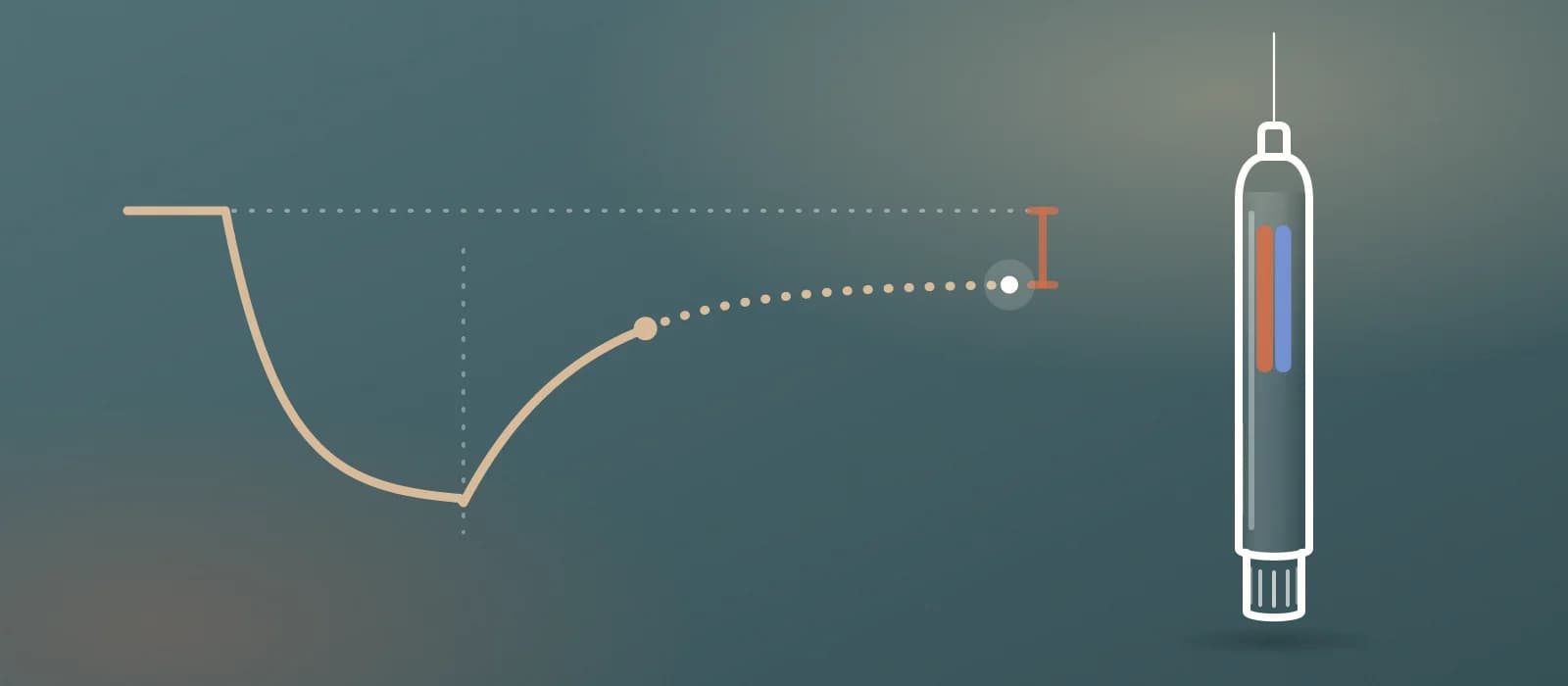
A quarter remains. How much that is depends on which group someone landed in: 5the spread during treatment The curve follows a model from six randomised trials with 3,236 people. The drawing rests on two sourced endpoints at the left, on measurements to week 52 in the middle, and on the model at the right. The pale band is assembled from the confidence intervals of height and rate. From week 52 it turns dashed, because out there it comes from that same model. Its narrowing comes from the model, whose height is better determined than its pace; whether the model holds that far, it does not say. How far individual courses lie apart is the mark at three months: 10 to 80 per cent, measured between trials, not between people. Because regain is counted as a percentage of the weight lost, the curve applies to any amount lost; the right edge shows how much of it stays off. Sources: Budini et al. 2026, Tzoulis and Baldeweg 2024
The curve falls to minus 15 per cent during treatment, rises steeply after stopping and then flattens. Share of lost weight regained after stopping: 3 months 24 %, 6 months 41 %, 9 months 52 %, 1 year 60 %, 18 months 68 % (model), 2 years 72 % (model), 3 years 75 % (model). Half the way back after 23 weeks. Plateau from week 60. After 3 months: 10 to 80 % back. What remains: around 1 %, 1 to 5 %, 5 % and more.It has also been reported that under treatment, eating out of tension, boredom or grief decreases in the short term. In one observational study it was back at its level from before treatment after twelve months. Whether the drug also changes the pattern by which someone manages their feelings has not yet been examined by any study.[2] That it was back after a year suggests, if anything, that the pattern had only gone quiet.
Why self-judgement matters so much
One possible cause of the distortion in the mirror is the judgement someone passes on their own weight. It came from outside. In a clinic that combines drug treatment with a behavioural programme, a third of the people did not return after the first appointment. Age, weight and existing conditions did not distinguish those who stayed from those who left. One characteristic set them apart: how harshly someone judged their own weight.[11] That same judgement went together with greater despondency and with the experience of having been devalued by others.
For men, a second reason comes on top. In interviews, men described how worrying about weight counts as a women's concern, and how talking about it calls their sense of themselves as men into question. In groups with women, that was what they found hardest. What mostly made them seek help at all was fear after a medical diagnosis.[12] That is the latest possible moment.
Why people take them without a medical need
Demand for these drugs reaches far beyond the licence, and the trigger then is often not a medical diagnosis but concern about one's own appearance.[6] On social media they appear as a tool for looking better. The comparison there is with pictures, and among them are ones altered with AI.[2] But the comparison is also with the fit people at the gym and the slim colleagues in the office, and anyone among them who is taking something does not have to say so. Nobody knows how many there are.
What the choice depends on
Every route has its price. With the drug it is a risk nobody can put a number on, and the fact that on average most of the lost weight returns after stopping: according to the model, about a quarter remains, five kilos out of twenty. That holds for many people taken together, not for the individual.[10] How long it should be taken is one of the open questions.[1] For the time after the drug, something else is usually needed.
With a change of diet and more exercise it is everyday life that changes: the shopping, the cooking, the evenings. The hard part is not starting but keeping going: after weight loss, weight comes back gradually for most people, and programmes of diet change and exercise slow that down. After two years they held off around one and a half kilos on average; beyond that the data barely reach.[13] And anyone who takes neither route is left with things as they are. Which price is the smallest depends on how much someone suffers from their weight.
None of these routes runs straight. After bariatric surgery, too, some of the weight comes back.[8] Two steps forward and one back is therefore not the failure of the route but its shape. Anyone who expects it can treat a setback as part of the process and carry on.
Self-judgement is what no route takes off your hands. The noise and the weight change quickly. After stopping, most of the weight returns on average, and users report that the noise comes back even sooner. The pattern by which someone manages their feelings, from the little that is known, only goes quiet. The judgement of others is far more sluggish: it barely follows the falling weight, and the effort even less. The same goes for the image in the mirror, and that one probably hangs on the judgement the person passes on themselves.
What came slowly goes slowly too. Five years after bariatric surgery the picture of one’s own body was still better than before, although the weight had long been climbing again.[8] What comes back is the weight. What can stay is the relationship to one’s own body.
Caring for your body and thinking kindly about it are two halves of one whole. That is what holistic means.
Where psychological counselling comes in
For as long as the quiet lasts, something can change. Not because there is more strength then, but because the noise is not getting in the way.
A review of the psychological side of these drugs explicitly recommends not letting drug treatment stand alone. It means conversations that work on behaviour, on feelings and on how someone treats themselves.[2] The work goes to what remains: the judgement about oneself, the pattern by which someone manages their feelings, and the picture of one’s own body. Counselling does not stand against medical treatment, it stands beside it. Whether this drug is the right one is decided in the doctor’s office. Where there is any suspicion of an eating disorder, depression or body dysmorphic disorder, a doctor or psychotherapist is the right person to treat it.
Anyone who wants to know whether that fits their own situation can find out in a free twenty-minute first meeting. Twenty minutes in which nothing has to be proven and nothing has to be decided. Sometimes that alone is the first moment of lightness.∎

Who will support you
Katharina Helms
Psychologist (M.Sc. Clinical Psychology)
I work with people online, in English, German and Spanish. Psychological counselling is not psychotherapy; where more support is needed, I help you find it.
More about me →Online by video · in English, German and Spanish